While the world squabbles over who should cut down carbon emissions and by how much, the wheels of doom are already set in motion. There’s a domino effect at play.
The rapid destruction and eventual collapse of the Amazon rainforest in Brazil might trigger catastrophic weather extremities more than 15,000 kilometers away in China and India.
There exists a strong correlation between the Amazon Rainforest Area(ARA) and the Tibetan Plateau(TP), reports an article published in the Nature Climate Change – “Teleconnections among tipping elements in the Earth system.” Also, there’s a correlation between ARA and the Western Antarctic.
It is bad enough that ecosystems across the world are collapsing. What this article highlights is that might all be connected to each other. The collapse of even one ecosystem due to climate change might lead to the collapse of another located on a different continent, unleashing a chain of ecological catastrophes.
Yes, much like what we saw in the movie 2012. But this isn’t a scenario from an end-of-the-world movie. This shit is happening now. In real-time.
Let’s get back to the article. To understand its significance, it’s essential to know that the Amazon rainforest, Tibetan Plateau, and the West Antarctic are climate tipping elements.
What Are Climate Tipping Elements, a.k.a Climate Tipping Points?
Imagine a rowdy cat sitting on a shelf and slowly pushing a vase. The vase inches ahead slowly, and at a certain point, it tips and descends toward destruction.
Humans are the rowdy cat. And with our activities like burning fossil fuels and deforestation, we have pushed certain geographic regions – crisscrossing international boundaries – to the brink of irreversible damage. These regions are undergoing drastic changes. They will ultimately collapse and destabilize the entire region if pushed beyond a threshold. These are the climate tipping elements.

There are at least nine major climate tipping elements :
- West Antarctic ice sheet loss
- Amazon rainforest dieback
- West African monsoon shift
- Permafrost thawing
- Coral reef die-off
- Indian monsoon shift
- Greenland ice sheet loss
- Boreal forest dieback
- Shutdown of the Atlantic Meridional Overturning Circulation
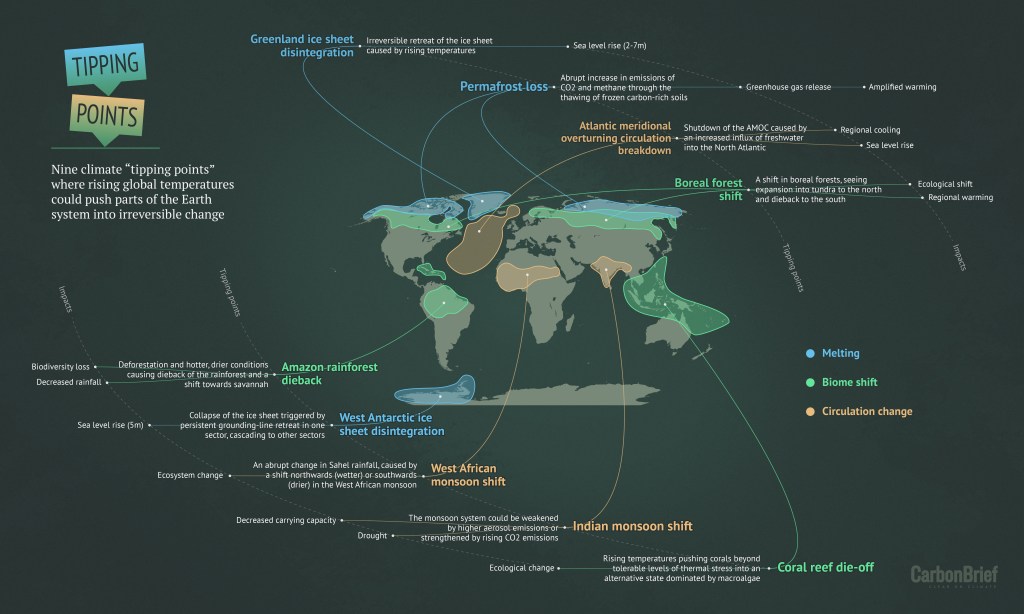
Picture courtesy: McSweeney, Robert. Explainer: Nine ‘tipping points’ that could be triggered by climate change. CarbonBrief.
Climate Tipping Elements Are Connected
If the Amazon rainforest is pushed beyond the tipping point, it would sound doom not just for Brazil, South America, or North America but even far away Asia and the Antarctic. That’s the significance of the study that I spoke about at the beginning of this blog, Teleconnections among tipping elements in the Earth system by Jingfang Fan, Saini Yang, Xiaosong Chen, and others.
They report that the tipping of the Amazon rainforest will have a direct impact on the Tibetan Plateau. Using historical data spanning 40 years (1979-2019), they established that a positive correlation exists between the two regions when it comes to temperature and a negative correlation when it comes to precipitation(rainfall).
Also, the destruction of large swathes of the Amazon rainforest means the loss of vegetation over hundreds of square kilometers and the release of billions of tons of carbon into the atmosphere. This would mean humans can forget trying to restrict the rise in global mean temperature to less than 2 degree Celsius, causing the tipping of even more climate tipping elements across the world.
Climate researchers are still trying to understand how various climate tipping elements are connected and how the ‘tipping over’ of one element might cause a cascading global impact. Of special interest are the climate tipping elements that are close to irreversible damage, like the melting of the Greenland ice sheet and Amazon rainforests.
The Greenland ice sheet is melting due to global warming, and this damage will become irreversible with a rise in global mean surface temperature of 0.8-3.2 degrees Celsius above the pre-industrial levels. Humans have already warmed the Earth to about 1°C above pre-industrial levels.
Amazon Rainforest Has Been FUBARed
More than 75% of the Amazon rainforest has lost resilience, meaning it has lost its ability to recover from droughts, forest fires, or other damages. This could push the rainforest – one of the climate tipping elements – beyond the tipping point, causing irreversible damage and turning the once lush green rainforest into a grassland. There has been no respite in the onslaught of the rainforest. Just this month, reports across media outlets raised the alarm over a 150% increase in deforestation of the Amazon in Brazil compared to the previous year.
Tibetan Plateau And Its Significance
The Tibetan Plateau is known as the Earth’s ‘Third Pole.’ It contains the largest reservoir of freshwater in the form of ice outside the polar regions and provides freshwater resources to 2Billion+ people. Ice from the Tibetan Plateau feeds water to some of the longest rivers in Asia, including the Yangtze, Mekong, Irrawaddy, Brahmaputra, and Ganges.
The UNEP, in its report ‘A Scientific Assessment of the Third Pole Environment’ mentions:
With an area of more than five million square kilometers, the region is the largest storehouse of snow and ice outside the Arctic and Antarctica, with about 100,000 square kilometers of glaciers in the area. As the highest ecosystem in the world with 14 highest mountain peaks, the region provides freshwater to more than 12,000 lakes and more than 10 river systems. With vast coverage, varied and complex ecosystems, the TP is significant in terms of climate regulation, hydrological cycle, and environmental processes. Apart from being the most important Asian ‘water tower’, hosting globally important alpine ecosystems and biodiversity, the TP is equally significant as home to a diverse community.
Like most climate tipping elements, the Tibetan Plateau is also impacted by global warming. The glaciers are melting, and the ice loss is accelerated. Apart from the threat of floods and other disasters this might cause, it also increases the public health risk of exposure to unknown microbes.
Conclusion
Well, there’s nothing more to say. The point of this blog was to drive awareness about Climate Tipping Elements and throw light on the latest research that has established a relationship between two climate tipping elements, the ARA and TP. This highlights the need for countries to work with each other on climate change despite differences because if nothing else unites us, then climate catastrophe will surely do.


Leave a Reply